
GD20W
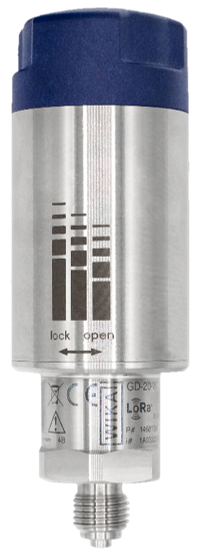
Description of the device
In order to prevent system failures in switchgear and network outages, the permanent monitoring of the gas density is essential.
The model GD-20-W calculates the current gas density from the pressure and temperature using a complex virial equation in the gas density sensor’s powerful microprocessor. Pressure changes resulting from temperature effects will be compensated by this and will not affect the output value.
For more information see product site.
GD20W Parser Quick Start
Parser API
All functions are pure (no global mutation) except adjustMeasuringRange which updates internal range configuration for subsequent decodes and encodes.
Types:
Input types:
interface UplinkInput {
  bytes: number[] // Raw payload as array of unsigned bytes (0-255)
  fPort: number // LoRaWAN FPort
  recvTime: Date
}

interface HexUplinkInput {
  bytes: string // Raw payload as hex-encoded string (case-insensitive, even length)
  fPort: number // LoRaWAN FPort
  recvTime: Date
}
Return type (shared by all decode helpers):
type Result = {
  data: Record<string, any> // Parsed key/value pairs
  warnings?: string[] // Non-fatal anomalies
} | {
  errors: string[] // Fatal or structural issues only
}
To understand the data field, take a look at the examples and the schema definition.
Supported channels to identify different sensors by:
// Is used in the returned data
type ChannelName = 'channel0' | 'channel1' | 'channel2' | 'channel3' | 'channel4' | 'channel5'
Channels that support adjusting the measurement range:
type AdjustableChannelName = 'channel0' | 'channel1' | 'channel2' | 'channel3' | 'channel4' | 'channel5'Channel Configuration
| Channel Name | Min Value | Max Value | Unit | Configurable |
|---|---|---|---|---|
| channel0 | 4 | 20 | mA | ✓ |
| channel1 | 4 | 20 | mA | ✓ |
| channel2 | 4 | 20 | mA | ✓ |
| channel3 | 4 | 20 | mA | ✓ |
| channel4 | 4 | 20 | mA | ✓ |
| channel5 | 4 | 20 | mA | ✓ |
decodeUplink(input)
function decodeUplink(input: UplinkInput): ResultdecodeHexUplink(hexInput)
function decodeHexUplink(hexInput: HexUplinkInput): Resultbytes must have even length; case-insensitive.
adjustMeasuringRange(channel, range)
// Will throw on invalid channel name or if the channel disallows range updates
function adjustMeasuringRange(
  channelName: AdjustableChannelName,
  range: {
    start: number
    end: number
  }
): void
Applies to future decodes only.
adjustRoundingDecimals(decimals)
// Smartly adjust number of decimals for rounded values
// Impacts all numeric values in all outputs
// Default is 4
function adjustRoundingDecimals(decimals: number): void
Applies to future decodes only.
encodeDownlink(input)
interface DownlinkInput {
  data: {
    protocol: 'TULIP2'
    input: {
      deviceAction: 'configuration'
      mainConfiguration?: {
        measuringRateWhenNoAlarm: number
        publicationFactorWhenNoAlarm: number
        measuringRateWhenAlarm: number
        publicationFactorWhenAlarm: number
      }
      channel0?: false | true | { alarms?: object }
      channel1?: false | true | { alarms?: object }
      channel2?: false | true | { alarms?: object }
      channel3?: false | true | { alarms?: object }
      channel4?: false | true | { alarms?: object }
      channel5?: false | true | { alarms?: object }
      configurationId?: number
      byteLimit?: number
    } | {
      deviceAction: 'resetToFactory'
    } | {
      deviceAction: 'resetBatteryIndicator'
      configurationId?: number
    } | {
      deviceAction: 'getConfiguration'
      mainConfiguration?: true
      channel0?: true | { alarms?: true }
      channel1?: true | { alarms?: true }
      channel2?: true | { alarms?: true }
      channel3?: true | { alarms?: true }
      channel4?: true | { alarms?: true }
      channel5?: true | { alarms?: true }
      configurationId?: number
      byteLimit?: number
    }
  }
}

function encodeDownlink(input: DownlinkInput): {
  bytes: number[]
  fPort: number
  warnings?: string[]
} | {
  errors: string[]
}
encodeMultipleDownlinks(input)
function encodeMultipleDownlinks(input: DownlinkInput): {
  frames: number[][]
  fPort: number
  warnings?: string[]
} | {
  errors: string[]
}
Verifying Ranges
All channels on the GD20W are 4-20 mA current loop inputs and are configurable. You must verify the actual measurement ranges from your device specifications or identification frames. The parser defaults to placeholder ranges that may not match your device configuration.
Using Identification Frames (TULIP2)
GD20W currently supports TULIP2. Look for identification message type 0x09 (extended device identification) to get actual channel ranges:
{
  "data": {
    "messageType": 9,
    "channelRanges": {
      "channel0": { "min": 0, "max": 12 },
      "channel1": { "min": 0, "max": 200000 }
    }
  }
}
Use channelRanges.channelX.min/max to configure the parser before decoding or encoding range-based values.
Quick Start
- Check your device's actual measurement ranges from purchase configuration, device specifications, or identification frames (see above)
- If your LNS (LoRaWAN Network Server) is compatible you need to wrap the code in a global function:
function decodeUplink(input) {
  // Replace the placeholder with the corresponding code from the artifact
  var __commonJSMin=(e,t)=>()=>(t||(e((t={exports:{}}).exports,t),e=null),t.exports)

  // Replace values with your device's actual measurement ranges from specifications or identification frames
  adjustMeasuringRange('channel0', { start: 0, end: 100 })
  adjustMeasuringRange('channel1', { start: 0, end: 250 })
// ... configure other channels as needed

  return decodeUplink(input)
}

function encodeDonwlink(input) {
  // Replace the placeholder with the corresponding code from the artifact
  var __commonJSMin=(e,t)=>()=>(t||(e((t={exports:{}}).exports,t),e=null),t.exports)

  // Replace values with your device's actual measurement range from specifications or identification frames
  return encodeDonwlink(input)
}- Add wrapper function if your network server is non-compliant:
function decode(input) { return decodeUplink(input) }
NPM Module Inclusion
| Device | Included | Factory function |
|---|---|---|
| GD20W | ✔️ | GD20WParser |